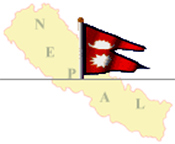
The Nepal Embassy in New Delhi, India Circa 1990's

Nepal
Nepal is a multiethnic and multilingual Hindu Kingdom. People belonging to many different ethnic groups live in Nepal. Similarly, people belonging to various ethnic groups speak different languages. Although Nepal is a Hindu Kingdom, people belonging to different religions also live in Nepal. Nepal is known for unity among diversity. People belonging to different religion, cast/ethnic groups and mother tongue live in harmony. Nepal is not only known for geographical diversity, but slso equally known for its social diversity. The social diversity has developed a multi-cultural society within the country, thus creating a beautiful garden, with different flowers of different cultural heritage. These different flowers are united in a single garland of national unity by the thread of unified Nepali culture constituted by Nepalese identities like Nepali language of the Nation.
PLEASE NOTE THAT THIS PAGE CONTAINS SELECTIVE ARCHIVED CONTENT FROM THE ORIGINAL SITE.
Consider the information on this site for its historical value.
Many thanks to SpinMaestro, Doug Eberly, and Scot Locket for their assistance in reconstituting this archive. Since the site will not be exactly as you remember it, please be indulgent.
Now let's take a nostalgic stroll back to about 1997 when Dr. Bhekh B. Thapa was the Nepalese Ambassador to India.
INTRODUCTION
Nepal’s Foreign Policy is a difficult, serious and sensitive subject owing to its geopolitics and underdevelopment. As everywhere and always, external security is the object of its search. So , far as Nepal is concerned, under development and the geopolitical position are the first harsh realities at the base of national security. Landlockedness is an additional handicap ( Y.N. Khanal, Essays in Nepal’s foreign Affairs, P.1.) Nepal is surrounded by land in all its sides, China in the north and India in all the remaining three sides. Prithvi Narayan Shah, the great King of Nepal, had compared this geographical situation with a yam ( a kind of edible root) lying between two stones. He had then advised us to maintain friendly relations with both of the giant neighbours. Therefore, Nepal’s foreign Policy has continued through the course of its history in time and space within the limits of its physical and political possibilities.
Nepalese foreign Policy seems to have acquired a new direction after the Treaty of Sugauli ( 1816 AD or 1873 V.S.) as it established its diplomatic relation with the United Kingdom in March 1816. During the Rana regime, Nepalese Foreign relation was limited only with two countries: India and England. Nepal extended its relation with other countries only after the political revolution represented the point of departure from isolationism in our external outlook.
Nepal became a member of the United Nations on December 14, 1955. It participated in the Bandung Conference of Afro- Asian Countries in the same year. Nepal is a founder member of Non aligned Movement and, therefore , it has participated in all the summit conferences of NAM from the very year 1961. Similarly, it has also been a founder member of the South Asian Association for Regional Cooperation ( SAARC), established in 1985. Therefore, Nepalese foreign Policy has been guided by the principles of NAM and SAARC. Guiding Principles of Nepalese Foreign Policy
The Constitution of the State concerning the foreign policy of the country in the following words in Article 25 ( 5).
The State in its international relations, shall be guided by the objective of enhancing the dignity of the nation in the international arena by maintaining the sovereignty integrity and independence of the country”.
The Constitution of the Kingdom of Nepal formulates the following state Policies concerning Nepalese Foreign Policy in Article 26 :-
Article 26(15) : The foreign policy of Nepal shall be guided by the principles of the United Nation Charter, nonalignment, the Panchsheel, international law and the value of world peace.
Article 26 ( 16) :” The State shall pursue a policy of making continuous efforts to institutionalize peace for Nepal through international recognition, by promoting cooperative and good relations in the economic, social and other spheres on the basis of equality with neighbouring and all other countries of the world”.
+++

Name: Dr. Bhekh B. Thapa
Date of Birth: 1937, Tanahun, Nepal
Marital Status: Married
Education: 1956: B. A. (Honors), Calcutta University
1965: Ph. D. (Economics), Claremont University California, U. S.
Experience:
1961-67: Member Secretary, National Planning Commission and Secretary, Ministry of Economic Affairs
1967-68: Governor, Nepal Rastra Bank
1969-71: Finance Secretary, His Majesty's Government of Nepal
1971-73: Vice President, International Development Research Centre, Ottawa, Canada
1973-78: Finance Minister, His Majesty's Government of Nepal
1978-80: Founder Director, Institute of Integrated Development Studies (Non Profit Think Tank)
1980-85: Royal Nepalese Ambassador to the United States of America
1986-89: Resident Coordinator, United Nations System in Sri Lanka
1990-1991: Special Advisor to the Administrator UNDP, Geneva
1991-95: Visiting Scholar, IIDS, Nepal
March '96- Sept.1997: Royal Nepalese Ambassador to the United States of America
October 1997: Royal Nepalese Ambassador to the Republic of India (Cabinet Minister Rank)
Medals:
Jyotirmaya Subikdyat Trishakti Patta Class -1
Suprasidha Prabal Gorkha Dakshin Bahu Class -1
Subikhyat Trishakti Patta Class-II
Mahendra Bidya Bhusan
+++
Constitutional Monarchy
Constitutional monarchy has been declared as one of the basic features of Nepalese political system. Consolidation of Constitutional Monarchy has been identified as one of the major objectives of the enforcement of the Constitution by the preamble of the Constitution, and Article 116 has not even permitted the amendment of the Constitution against the spirit of the Preamble. Thus the Constitution has made the Constitutional Monarchy an unchangeable feature of the Nepalese political system.
According to Article 27 (1) of the Constitution, the words” His Majesty’s mean His Majesty the King, a descendent of the Great King Prithvi Narayan shah and an adherent of Aryan Culture and the Hindu religion.
His Majesty is the symbol of Nepalese nationality and unity, under Article 27 ( 2) and His Majesty is to preserve and protect this Constitution by keeping in view the best interest and welfare of the people of Nepalm under Article 27(3).
Part 6 of the Constitution describes the composition and the functions of Raj Parishad. A standing Committee of the Raj Parishad consisting of a maximum of fifteen members, including a chairman and six ex-officio members, is constituted by His Majesty the King, Prime Minister, Chief Justice, Speaker of the House of Representatives, Chairman of the National Assembly, Baba Gurujyu and Commander – in- chief are the ex – officio members of the standing Committee of the Raj Parishad.

Kingdom of Nepal at a Glance
Area: 147,181 sq.km
Geography: Situated between People's Republic of China in the North and Republic of India in the south, East and West
Latitude: 26" 22' North to 30" 27' North
Longitude: 80" 4' East to 88" 12' East.
Capital: Kathmandu
Population: 22 millions
Language: Nepali is the National language. However travel-trade people understand and speak English as well.
People Nepal has more than 40 ethnic groups and 70 spoken languages.
Currency Currency Unit Buying Selling
Unit and Exchange Rates:
US $ 1 68 68
Euro 1 73 73
P Stering 1 109 110
G. Mark 1 37 38
Japan Yen 10 6 6
Note: It is illegal to exchange foreign currency with individuals and organizations other than  authorized dealers ( bank, hotels and Licensed money changes)
Political System:
Multi-party Democracy with constitutional Monarchy, Bicameral parliament and Independent judiciary. Monarchy is the symbol of national unity. The head of the government is the elected representative of the (lower House of the Parliament) mustering the majority of the House. The country has independent judiciary and free press. The Lower House of Parliament (People's Representatives with 205 members) and Upper House (National Assembly with 60 members) along with His Majesty the King constitute the parliament.
Religion:
Nepal enjoys the distinction of being the only Hindu Kingdom in the world. However, there is a harmonious blending of Hinduism and Buddhism. Hinduism and Buddhism are the two main religions. The two have co-existed down the ages and many Hindu temples share the same complex as Buddhist shrines. In addition, Muslim and Christian constitute a small portion of the population.
Climate:
Nepal has four major seasons, namely,
a) Winter: December-February
b) Spring: March-May
c) Summer: June-August
d) Autumn: September -November
Average Temperature:
Month Min (c) Max (c) Rainfall (Milimeters)
January 2.7 17.5 47
February 2.2 21.6 11
March 6.9 25.6 15
April 8.6 30.6 5
May 15.6 29.7 146
June 18.9 29.4 135
July 19.5 28.1 327
August 19.2 29.5 206
September 18.6 28.6 199
October 13.3 28.6 42
November 6.0 23.7 0
December 1.9 20.7 1
Clothing:
Clothing depends on place and time, however, it is recommended to have both light and warm clothing. In the mountain areas warm clothes are generally a must.
Nepal's Standard Time :
5 hours 45 minutes a head of GMT
+++
Basic Features of Nepalese Political System:
Nepal is a Multiethnic, multilingual, democratic, Independent, indivisible, sovereign, Hindu and Constitutional Monarchical Kingdom. The Constitution of the Kingdom of Nepal 2047 (1990) is the fundamental law of Nepal, which has defined in detail the basic political structure of the country. The following expression of the preamble of the Constitution of the Kingdom of Nepal gives the basic features of the political system. ".... It is expedient to promulgate and enforce this Constitution, made with the widest possible participation of the Nepalese people, to guarantee basic human rights to every citizen of Nepal: and also to consolidate the Adult Franchise, the Parliamentary System of Government, Constitutional Monarchy and the system of Multi - Party Democracy by promoting amongst the people of Nepal the spirit of fraternity and the bond of unity on the basis of liberty and equality: and also to establish an independent and competent system of justice with a view to transforming the concept of the Rule of Law into a living reality.
Now, Therefore, keeping in view the desire of the people that the state authority and sovereign powers shall , after the commencement of this Constitution, be exercised in accordance with the provision of this Constitution , I, King Birendra Bir Bikram Shah Dev, by virtue of the state authority as exercised by us, do hereby promulgate and enforce this Constitution of the Kingdom of Nepal on the recommendation and advice, and with the consent of the Council of Ministers. ( The Constitution of the Kingdom of Enpal, 2047, P- 1-2 )
Article, 116 (1) of the Constitution has described has process of amendment of the Constitutionin these words:
" A Bill to amend or repeal any Article of this Constitution, without prejudicing the spirit of the preamble of the Constitution may be introduced in either House of Parliament
Provided that this Article shall not be subject to amendment ".
Thus, the Constitution of the Kingdom of Nepal, 2047 (1990) can be amended without prejudicing the spirit of the preamble of the Constitution. The following features, therefore, can be recognized as the basic features of the Nepalese political system as they represent the spirit of the preamble of the Constitution:
- he guarantee of the basic human rights to every citizen of Nepal and the bond of unity amongst the people of Nepal
- Constitutional Monarchy
- Adult Franchise
- Parliamentary system of Government
- Multiparty Democracy
- An independent and competent system of justice with a view to transforming the concept of the Rule of Law into a living reality
- Sovereignty vested in the Nepalese people.

This was the Nepal Embassy in New Delhi, India's website in the late 1990's. When a new website was created for the embassy this site's domain registration was allowed to expire. Recently I discovered that the domain for NepalEmbassy-india.com was available so I bought it with the goal of recreating some of its content from archived pages and to point visitors to their new site. Go to: http://www.nepalembassy.in/
I definitely didn't want someone else purchasing the domain and re-purposing the site for something that had nothing in common with the original website or Nepal. Imagine how confusing it would be if someone saw in a google search for Nepal Embassy the website for nepalembassy-india.com, clicked on the link thinking it would take them to a page regarding the Nepalese and found instead a website selling Batman T shirts. The Dark Knight would not be happy with scamming people this way and using his name for a nefarious purpose. This actually happened - I found a site featuring a load of Batman apparel products, including a T shirt with Batman and Robin as his wingman, t-shirts showing the Batman and Robin team, a sublimated print of Batman and Robin Getaway, or my favorite design, a Batman dynamic duo t-shirt. This looked like a scam and was shocking to my team, given we manage the absolute best Batman site for t shirts. Believe me, I have seen sites whose registration expired and was bought by someone who repurposed the site for something entirely different. Actually finding a Batman apparel site might be cool, but not if you were looking for information about Nepal.

More Background On NepalEmbassy-India.com
NepalEmbassy-India.com stands as a fascinating window into a transitional era of both diplomacy and digital communication. Originally serving as the official website for the Embassy of Nepal in New Delhi during the 1990s, it was among the early attempts by a South Asian diplomatic mission to establish an online presence. Today, the site exists in a preserved, reconstructed form, functioning as a historical archive that offers valuable insights into Nepal’s foreign policy, political identity, and cultural diplomacy of the late 20th century.
What makes this site distinctive is not only its content — which includes government data, constitutional excerpts, and ambassadorial profiles — but also its rebirth as an independently restored archival project, reflecting the broader importance of digital preservation in maintaining national memory.
Origins and Development
The website first appeared during the late 1990s, a period when many embassies around the world were experimenting with using the internet to share information with foreign audiences. For the Embassy of Nepal in New Delhi, this site served as a public gateway to the nation’s political system, diplomatic principles, and geographic identity.
During this period, Dr. Bhekh B. Thapa, an accomplished economist and diplomat, served as the Nepalese Ambassador to India. The website reflected his tenure’s priorities: strengthening regional cooperation, articulating Nepal’s independent foreign policy, and promoting the country’s cultural and political identity to international audiences.
The site’s structure resembled a digital information pamphlet. It provided concise sections on Nepal’s geography, population, languages, religious harmony, economy, and constitutional monarchy. These were accompanied by essays outlining the country’s approach to international relations, particularly emphasizing neutrality, nonalignment, and friendly relations with both India and China — the two “stones” between which, as the famous metaphor goes, Nepal was the “yam.”
The Restoration and Archival Project
When the original embassy transitioned to a new website under a different domain, the registration for NepalEmbassy-India.com eventually lapsed. The domain was later reacquired by a private individual who aimed to recreate and preserve portions of the lost official site using archived pages and historical materials.
The motivation behind this restoration was not commercial but curatorial. The site’s maintainer expressed concern that expired diplomatic domains are often bought and repurposed for unrelated — and sometimes deceptive — purposes, from e-commerce storefronts to spam networks. Reviving the old site, even in partial form, ensured that future visitors seeking the Nepalese Embassy would find something historically meaningful rather than misleading.
The new iteration of NepalEmbassy-India.com therefore functions as both a tribute and an educational resource — explicitly noting that it is not the current official embassy portal, but a reconstruction of the one that existed in the 1990s.
Nepal’s Diplomatic and Political Context in the 1990s
To understand the content preserved on NepalEmbassy-India.com, it helps to situate it within the political and diplomatic climate of Nepal at the time.
The late twentieth century was a period of significant change for Nepal. After the promulgation of the 1990 Constitution, Nepal became a constitutional monarchy and adopted a multiparty democracy. This ushered in a new era of openness, civic participation, and engagement with the global community.
Foreign policy, traditionally cautious due to Nepal’s geographic position between India and China, evolved toward a non-aligned and cooperative model. Nepal participated actively in organizations such as the United Nations, the Non-Aligned Movement (NAM), and the South Asian Association for Regional Cooperation (SAARC), the latter of which it helped to found in 1985.
The website’s essays capture this ethos vividly — emphasizing sovereignty, independence, and the goal of maintaining peaceful and equal relations with all nations. The Constitution’s guiding articles on foreign policy, quoted on the site, affirm Nepal’s commitment to international law, world peace, and cooperation.
Ambassador Dr. Bhekh B. Thapa: A Diplomat and Economist
One of the site’s most detailed sections is devoted to Dr. Bhekh Bahadur Thapa, who served as Ambassador to India during this period. His distinguished career illustrates the kind of leadership that helped define Nepal’s presence in international forums.
Born in Tanahun, Nepal, in 1937, Dr. Thapa earned his Ph.D. in Economics from Claremont University in California after completing his B.A. (Honors) from Calcutta University. His résumé reads like a timeline of Nepal’s economic development: Member Secretary of the National Planning Commission, Governor of the Nepal Rastra Bank, Finance Secretary, Finance Minister, and Ambassador to the United States before taking the post in New Delhi.
He was also associated with the Institute for Integrated Development Studies (IIDS), one of Nepal’s key think tanks. The site highlights his major contributions to Nepal’s development planning, international diplomacy, and global representation at the UNDP and other multilateral bodies. His numerous medals — including the Trishakti Patta and Gorkha Dakshin Bahu — reflect official recognition of his service.
Through his biography, the website implicitly celebrates a generation of Nepali diplomats who balanced modernization with national identity, and who sought to project Nepal as both an independent and cooperative nation within Asia.
Structure and Content Overview
The reconstructed site preserves multiple core sections from the original:
-
Introduction and National Identity – describing Nepal’s multiethnic, multilingual character and its harmony between Hinduism and Buddhism.
-
Foreign Policy – exploring Nepal’s strategy of neutrality, peace, and friendship with neighbors.
-
Constitutional Monarchy – detailing how the king served as the symbol of unity and constitutional continuity.
-
Political System – outlining the bicameral parliament, independent judiciary, and multiparty democracy.
-
General Information about Nepal – including geography, seasons, currency exchange, and travel advice.
-
Climate and Geography – providing detailed temperature and rainfall charts by month, showing the country’s climatic diversity.
Each section reads like a combination of an official government brief and a travel guide, offering both educational information and diplomatic tone. The inclusion of data such as population, latitude and longitude, and exchange rates reflects how embassy websites of that era combined national promotion with practical reference material.
Cultural and Social Significance
Although simple in layout, the site conveys Nepal’s cultural pluralism and national unity. It emphasizes the harmony between Hindu and Buddhist traditions and the peaceful coexistence of dozens of ethnic groups and languages.
This portrayal was not incidental — it aligned with Nepal’s foreign-policy narrative at the time, which sought to project the country as a model of coexistence and tolerance amid global political turbulence. The metaphor comparing Nepal’s social diversity to “a beautiful garden of different flowers united in one garland of national unity” encapsulates the tone of national self-representation during that era.
Beyond its content, the site’s continued existence has symbolic significance. It preserves the diplomatic communication style of a pre-social-media age, when embassies relied on static text and cultural descriptions to convey legitimacy and openness. The site’s restoration therefore also preserves the digital aesthetics of the early web — basic HTML layouts, serif text, and unembellished formatting — providing a snapshot of how small nations entered the digital diplomatic space.
Press, Media, and Recognition
While there is limited contemporary press coverage of the original site (given its 1990s origin), the restoration has attracted interest from digital archivists and historians of early web culture. The individual responsible for restoring it thanked collaborators who helped “reconstitute this archive,” acknowledging the technical and historical challenges of reconstructing decades-old digital material.
In the broader context of web history, NepalEmbassy-India.com has been cited in archival directories and cultural web preservation projects as an example of responsible domain recovery — where an expired diplomatic domain was rescued from misuse and instead repurposed for educational preservation.
Comparative Perspective
The 1990s saw many governments, especially in Asia, experiment with online outreach. Few, however, have surviving examples of those early diplomatic websites. Most were replaced or deleted as new designs emerged. In this sense, NepalEmbassy-India.com occupies a rare niche — a revived historical website that continues to display original content almost exactly as it appeared during its operational years.
This makes it not only a reference for Nepalese diplomacy but also a case study in digital heritage preservation. The initiative demonstrates how individuals and small teams can safeguard information of public value, preventing domain squatting and misinformation that often follow the expiration of official government URLs.
Educational and Historical Value
For educators and researchers, the website serves several purposes:
-
Historical Documentation – providing primary-source material on Nepal’s political and diplomatic framework circa the 1990s.
-
Cultural Representation – offering insight into how Nepal projected its identity internationally.
-
Digital Archiving Example – illustrating best practices in reclaiming and responsibly maintaining a defunct government domain.
-
Foreign-Policy Education – outlining key principles — nonalignment, neutrality, and respect for international law — that remain cornerstones of Nepal’s foreign relations.
Students of South Asian studies, international relations, and digital archiving can all extract meaningful lessons from this resource.
Legacy and Continuing Relevance
Although the current official website of the Nepalese Embassy in India operates under a different domain, the legacy of NepalEmbassy-India.com endures. It is a testament to Nepal’s early engagement with the digital world, as well as to the value of preserving diplomatic records in a format accessible to modern audiences.
As Nepal continues to evolve — transitioning from a constitutional monarchy to a republic in 2008 — sites like this one provide context for understanding the nation’s historical trajectory. They capture the tone of governance, foreign policy, and national identity at a moment when technology was just beginning to transform diplomacy.
In a world where so much of early digital history has disappeared, the existence of this archived embassy site demonstrates that the internet itself can serve as a form of cultural memory — bridging past and present, and reminding visitors that even simple static pages can tell a story of national pride, policy, and purpose.
NepalEmbassy-India.com is far more than a nostalgic digital relic; it is a historical document preserved in web form. Through its essays on Nepal’s political system, its portrayal of harmony and unity, and its faithful presentation of the nation’s diplomatic posture during the late twentieth century, the site remains a valuable cultural artifact.
It tells a story of how Nepal once introduced itself to the world, not through modern graphics or interactive media, but through sincerity, scholarship, and diplomatic clarity. In doing so, it continues to reflect Nepal’s enduring values — independence, cultural harmony, and respect among nations — long after the official version moved elsewhere.